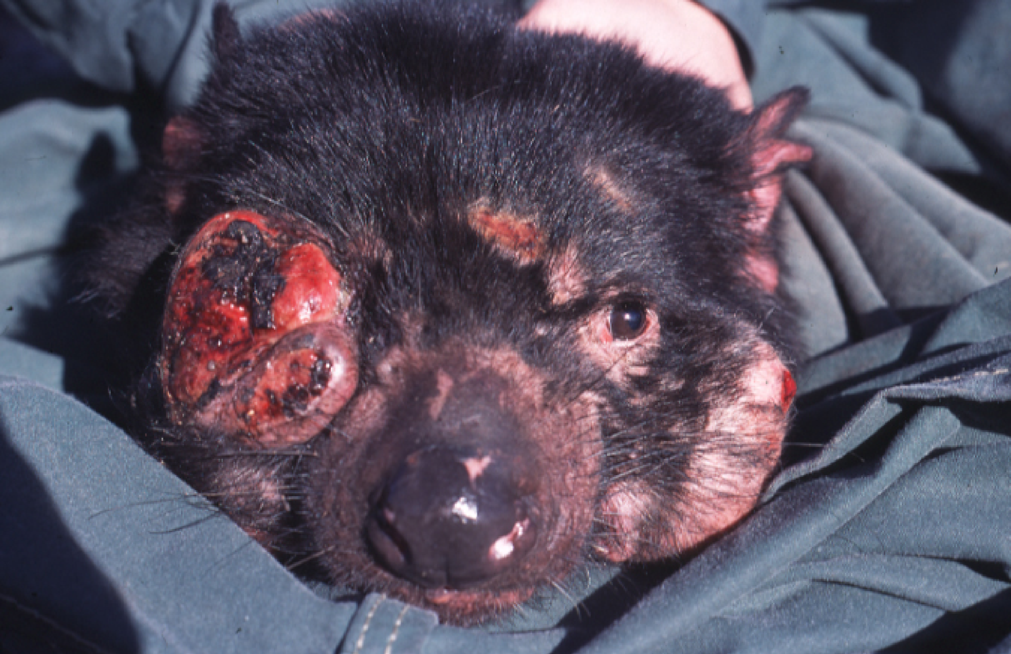
The Sarcophilus harrisii, also known as the Tasmanian Devil is a carnivorous mammal weighing between 9-26 pounds at a length between 20-31 inches. This mammal is considered endangered with a decreasing population and has a life expectancy of about 5 years. They are covered in coarse brown fur with a stocky stature with white strips underneath their belly and spots along the side of their body. Their pig-like stance is due to its longer front legs and shorter rear legs. Tasmanian devils feed off of smaller prey like snakes, bird, fish, insects and carrion. They like to burrow in habitats such as logs and caves, forests, grasslands, scrubland, vegetation and then awake to feed at night on prey. Tasmanian devils are reproduced and given birth to about 20-30 young after 2-3 weeks of pregnancy. They then go into their mother's pouch, but only few survive because the mother has 4 nipple only for feeding.
The National Geographic States, “Tasmanian devils are now indigenous only to the island state of Tasmania. Their Tasmanian range encompasses the entire island, although they are partial to coastal scrublands and forests. Biologists speculate that their extinction on the mainland is attributable to the introduction of Asian dogs, or dingoes. Their extinction could be due to the fact of the efforts in the late 1800s to eradicate Tasmanian devils, which farmers erroneously believed were killing livestock (although they were known to take poultry), were nearly successful.
In 1941, the government made devils a protected species, and their numbers have grown steadily since.” An illness discovered in the 90s has killed tens of thousands of Tasmanian devils. Called devil facial tumor disease, this condition is a rare contagious cancer that causes large lumps to form around the animal's mouth and head, making it hard for it to eat. The animal eventually starve to death.
IUCN Redlist Citation Hawkins, C.E., McCallum, H., Mooney, N., Jones, M. & Holdsworth, M. 2008. Sarcophilus harrisii. The IUCN Red List of Threatened Species 2008: e.T40540A10331066. http://dx.doi.org/10.2305/IUCN.UK.2008.RLTS.T40540A10331066.en. Downloaded on 07 November 2019.
https://www.nationalgeographic.com/animals/mammals/t/tasmanian-devil/

Section 2:
The Tasmanian Devil lives in a temperate biome in Tasmania and experiences all 4 seasons. Summertime is from December to February, the dry season. While June and July, the winter season, are the wettest and coolest months. Rainfall on the western side usually reaches to 57 inches. The amount of rainfall from month to month differs from where someone is in Tasmania. The rainfall is distributed evenly but sometimes a high amount can come during June and July. The lowest amount for rain is during the summer. During the summer the temperature ranges from 17-23 degrees. Celsius and the winter ranges from 3-11 degrees Celsius.Temperate rain forests are found along the Pacific coast of the United States and Canada, in New Zealand, Tasmania, Chile, Ireland, Scotland and Norway. Australia has two types of temperate rain forrests. Tasmania being located in the cooler temperate,its cool temperate rain forest is home for mammals like the Tasmanian long-tailed mouse, ringtail possum, spotted tail quoll and pademelon.
Many species of birds can be found here as well, including black currawong, green rosella, olive whistler and grey goshawk. Reptiles in this biome can include the Tasmanian tree frog, tiger snake and brown skink. Ancient and primitive invertebrate include the large land snail, Macleay's swallowtail butterfly, freshwater crayfish and velvet worm.
https://sciencing.com/animals-temperate-rainforest-biome-6801694.html
Another unusual species in Tasmania is,The Daintree River Ringtail Possums are born with dense, light brown woolly fur, which remains the same as they become adults. They have a dark stripe along the back and head. These possums can be distinguished by a pointed snout with a “roman nose” and a tapering tail. The Ringtail Possum needs to live in this habitat because they are threatened by temperature extremes, storms, flooding, and habitat shifting. This causes them to live in higher elevations. Pseudochirulus cinereus, Ringtail Possum, is found only in tropical rain forests in Australia. They are adapted to living at higher elevations, above 300-450m, and are found on mountaintops. This habitat has fairly cool temperatures throughout all 4 seasons, and depends on rainfall and plants for vegetation on land to stay wet during its winter time, and becomes dry but still cool in the summertime.
https://www.iucnredlist.org/species/18508/21962025

Section 3:
In the temperate biome, Dingoes are a threat and predator to Tasmanian Devils. They hunt and feed off of baby Tasmanian devils in their dens. They pursue small game such as rabbits, rodents, birds, and lizards. These dogs will eat fruits and plants as well. The dingoes and Tasman Devils fight for the same prey and so the dingoes become a competitive hunter with the Tasmanian Devil. Biotic factors that are affected would be a decrease in Tasmanian Devils because the Dingoes would be eating their same prey creating a lack of food for the Tasmanian's. Plants and fruits would be decrease in population as well because of the increase in Dingoes.
Another biome would be a tropical rain forest. In the tropical rain forest both the Dingoes and
Tasmanian's would not survive due to the lack of caves and burrows for the Tasmanian's to live in and there are not as many plain lands or mountains for Dingoes to live in.
According to Earth Observatory, The tropical rain forest biomes’ habitat consists of “Being found closer to the equator where it is warm. The tropical rain forest is a hot, moist biome where it rains all year long. It is known for its dense canopies of vegetation that form three different layers. The top layer or canopy contains giant trees that grow to heights of 75 m (about 250 ft) or more. This layer of vegetation prevents much of the sunlight from reaching the ground. Thick, woody vines are also found in the canopy. They climb trees in the canopy to reach for sunlight. The middle layer, or under story, is made up of vines, smaller trees, ferns, and palms.” The habitat is more tree and vine heavy rather than landscapes and places to burrow or for Dingoes to roam. Causing this is the amount of vegetation and then constant rainfall each year.
https://earthobservatory.nasa.gov/experiments/biome/biorainforest.php
https://tasmaniandevil.net/why-are-tasmanian-devils-endangered/
https://www.nationalgeographic.com/animals/mammals/d/dingo/

Section 4:
When looking for a solution to bring back the population of Tasmanian devils you are able to find some organizations that are taking steps. One organization for example is the “Save the Tasmanian Devil Organization” They are based in Tasmania and help the current wild population of devils. The organization does plenty of things to help the population.
For example, they go out into the wild looking for devils and they have created a vaccine to inject into the animals mouths to hopefully prevent Devil facial tumor disease. Once they have caught the devil they put a microchip into its body and then proceed to register it and log it. By doing this they can locate the devil and keep checking up on it to make sure it is healthy and not developing the mouth tumors. Save the Tasmanian Devil Organization also has a breeding program they have over thirty enclosures that hold the devils and it is growing. This organization in Tasmania is doing some of the greatest work to save these creatures and bring them back to full fruition.

https://tasmaniandevil.net/why-are-tasmanian-devils-endangered/